
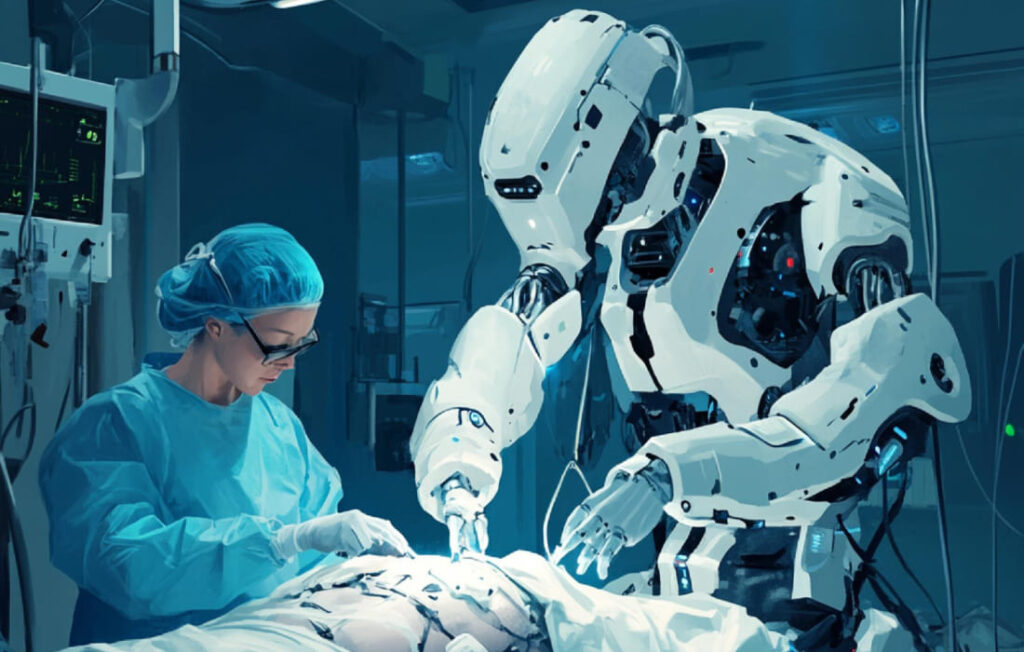
A groundbreaking robotic system has successfully performed a complex throat tumour removal, marking a major leap forward in minimally invasive surgery.
In a landmark procedure that could redefine head and neck surgery, a team of surgeons at St. Thomas’ Hospital in London has successfully used a next-generation robotic surgical system to remove a malignant throat tumour from a 54-year-old patient. The operation, performed earlier this month, utilized the Versius Surgical System — a compact, modular robot developed by CMR Surgical — in a procedure that demonstrated unprecedented precision, flexibility, and patient recovery benefits.
The patient, who has chosen to remain anonymous, was diagnosed with a squamous cell carcinoma located deep within the oropharynx — a notoriously difficult area to access via traditional open surgery. The tumour was situated near critical structures, including the carotid artery, vocal cords, and multiple cranial nerves, making it a high-risk procedure. However, the Versius system’s advanced articulation and 3D visualization allowed the surgical team to navigate this complex anatomy with remarkable accuracy.
“This is a paradigm shift for head and neck oncology,” said Dr. Mark Harrington, lead surgeon on the procedure and a consultant ENT specialist. “We’ve been able to achieve clear margins — removing the entire tumour — while preserving the patient’s swallowing function, voice, and quality of life. That simply wasn’t possible to this degree with conventional techniques even five years ago.”
A Breakthrough in Robotic Surgery
The Versius system, which was first introduced in 2019 and has since been adopted by hospitals across Europe, Asia, and the Middle East, represents a new generation of surgical robotics. Unlike the larger, more cumbersome Da Vinci system, Versius features:
-
Lightweight, modular arms that can be positioned independently around the patient.
-
Wristed instruments offering 360-degree rotation and seven degrees of freedom.
-
3D HD vision with 10x optical zoom and fluorescence imaging to highlight vascular structures.
-
Smaller port sizes (5mm) that significantly reduce scarring and post-operative pain.
-
Surgeon-controlled haptic feedback, providing tactile sensation during tissue manipulation — a first for many robotic platforms.
These features make it particularly suited for procedures in confined anatomical spaces like the throat, where visibility and dexterity are paramount.
The Procedure: A Case Study
The surgery was performed transorally — meaning the instruments and camera were inserted through the patient’s mouth, eliminating the need for external incisions. Using the Versius system, Dr. Harrington and his team were able to:
-
Visualize the tumour in high-resolution 3D through a flexible endoscope.
-
Map critical structures using fluorescence imaging to avoid blood vessels and nerves.
-
Resect the tumour with millimetre precision, ensuring clear margins of at least 3mm of healthy tissue.
-
Close the defect using absorbable sutures applied via the robotic arms.
The entire procedure took three hours and 15 minutes — significantly shorter than the five to six hours typically required for open surgery. The patient was extubated immediately after the procedure and moved to the recovery ward within two hours.
Advantages Over Traditional Surgery
The results speak for themselves:
-
Hospital Stay: 5–7 days (traditional) vs. 2 days (Versius robotic procedure)
-
Recovery Time: 4–6 weeks (traditional) vs. 7–10 days (Versius robotic procedure)
-
Scarring: Large neck incision (traditional) vs. None — transoral approach means no external scars (Versius)
-
Blood Loss: Significant at 300–500ml (traditional) vs. Minimal at less than 50ml (Versius)
-
Swallowing/Voice Impact: High — often permanent damage (traditional) vs. Low — near-normal function preserved (Versius)
-
Infection Risk: Moderate (traditional) vs. Low (Versius)
-
Nerve Damage Risk: 15–20% (traditional) vs. Less than 5% (Versius)
“We’re seeing patients who undergo robotic-assisted ENT surgeries go home in a fraction of the time, with significantly less pain and a much faster return to normal activities,” said Dr. Sarah Jenkins, a robotics researcher at Imperial College London who was not involved in the procedure. “The economic implications are enormous — not just for patients’ quality of life, but for healthcare systems strapped for beds and resources.”
The Future of Robotic ENT Surgery
This successful procedure is just the beginning. CMR Surgical has announced plans to develop specialized ENT-specific instruments, including micro-debriders and laser fibers, that would further expand the Versius system’s capabilities in ear, nose, and throat procedures.
Meanwhile, competitors such as Medtronic and Stryker are investing heavily in their own robotic platforms for head and neck surgery, indicating a rapidly growing market. Analysts project the global surgical robotics market to exceed $25 billion by 2030, with ENT applications being one of the fastest-growing segments.
However, challenges remain. The cost of robotic systems — often exceeding $2 million per unit — creates significant barriers for smaller hospitals and public healthcare systems. Training and credentialing surgeons to proficiency with the system is another hurdle, requiring dedicated simulation time and proctored cases.
Dr. Harrington remains optimistic: “The cost will come down over time, just as it did with laparoscopic surgery. What matters today is that we’ve proven the clinical benefit. This isn’t experimental anymore — it’s a viable standard of care for selected patients. And that changes everything.”
Expert Opinion
We reached out to Dr. Emily Chan, a surgical oncologist specializing in head and neck cancers, for her perspective:
“This is genuinely exciting. The throat is one of the most challenging areas to operate on — every millimetre counts. If the Versius system can consistently deliver these results, we could see a dramatic shift away from open procedures, which often leave patients with lifelong functional deficits. The fact that this patient is already talking and swallowing normally is nothing short of remarkable.”
Patient Outcome
At the time of writing, the patient has been discharged and is recovering at home. Follow-up scans are scheduled for three months to confirm complete remission, but the margins achieved during surgery offer strong grounds for optimism. The patient, in a statement released through the hospital, said:
“I can’t believe how little pain I’m in. I was expecting to be bedridden for weeks. Instead, I’m already back to walking the dog and eating solid food. This technology is incredible.”